You've got folks thinking constantly about advertising, pricing strategies, dark patterns, network effects that prevent or discourage churn, etc., in ways that tend to exploit flaws in the consumer's decisioning process or gaps in their knowledge, to the consumer's disadvantage.
It feels rare to see an actual new valuable product or improvement.
Look at all the ASKJKL type uppercase brands on amazon.
Meanwhile trusted/established brands are impossible to search for specifically.
And established brands are bought and sold to bad new owners. Pyrex was sold and doesn't make good (borosilicate) glass products anymore. Segway went to ninebot.
I'm sure there are lots of examples of this...
https://www.amazon.com/stores/Bose/page/9E24AFD5-B420-4859-B...
I don't think that Segway was ever considered trusted or established. It has always been kind of a goofy niche product used by guided tour groups and mall security.
One is, you want a phone with drivers in the kernel tree so you can keep putting the latest version of vanilla Android on it without relying on the OEM. Except the market is too concentrated and then nobody makes that. Competition fixes this.
The other is, if you give people the choice between a $200 plane ticket with two checked bags and lots of leg room and a $170 plane ticket where it's standing room only and you can't check bags because the airline is reselling the cargo area of the plane to UPS, customers pick the second one. And then a competitive market provides you with that option which people choose and then complain about it even though the alternative is available. Choosing differently fixes this.
If passengers are forced to pack lightly because they have to pay extra fees is actually a win-win-win for everyone. Plus it is less discriminatory because my airfare is not subsidizing someone else abuse of the system.
Same goes with food. I want the option to not pay for the shitty airline food.
A common way to price discriminate is to make the cheaper options take time and effort to obtain. People with less money will put in more time and effort e.g. price comparison, looking for discounts (codes or whatever), taking a few days to check prices, willing to move travel dates/times to get a cheaper price. Those with more money pay more and value their time/effort more highly.
Flight prices are not random - they are highly optimised (even using genetic A/B price generation algorithms that the airlines themselves might not fully be able to predict).
PS: Avoid LATAM Airlines Chile - dark pattern on website - those bastards increased the price while I was entering the credit card to pay (a popup - was ~2% but a dirty trick - maybe discrimination after detecting card owner credit details?).
I don't know where you live but in the US this is patently not true.
Airlines are an abusive oligopoly there, with landing slots and the like cementing control of certain markets for certain airlines.
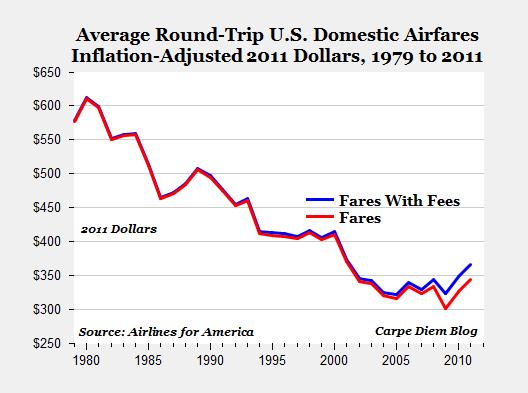
Ticket prices are much higher than they used to be and are much higher than Europe (for instance).
https://www.aerotime.aero/articles/most-profitable-airlines
I think there are lots of airlines that are propped up by governments that lose money leading to the meme you're quoting. Many industries were affected by the events you quoted, those sorts of things aren't specific to airlines.
1) Survivorship Bias: you are only looking at airlines that currently exist, and ignoring ones that have gone out of business.
2) Recency Bias: you're examining them at a time of relative prosperity and stability, ignoring their pasts.
Though I blame no one, if people want comfort they can pay more or travel less (if possible)
This entire article is about how airlines are unbundling their offerings and doing market segmentation through "optional" add-ons...
Average fares are skewed by low cost carriers entering the market.
>Average fares are skewed by low cost carriers entering the market.
The low cost carriers business model is to fly new routes (to secondary airports if required) at low prices, often creating new demand (Breeze is a classic example of this).
The math is very straight forward if you consider what each group is doing in the market.
You see an oligopoly, but the barrier to entry is as much defined by the thin margins and high capital cost as anything else.
Both statements could be true simultaneously, of course.
If you're the seller, then it's easy to filter out customers who don't fit into category A, with pricing. For the customer it's harder to filter out sellers who don't fit into category B, but generally you won't find them if you're looking for a bargain.
Just because an issue existed long ago does not mean it has continuously existed or is intractable.
1. airline ticket holder minutes wasted due to flight delays and cancelations.
2. amount of jet fuel wasted on empty flights for the purpose of keeping gate privileges.
3. money spent attempting to acquire or merge with other airlines and attendant FTC defense preparation.
4. (any and all other wastes of revenue that do not get invested in the consumer and instead are paid by the consumer).
There is more to the story than the price per mile. And that's not even opening the can of worms that is the quality and comfort of the flight for the consumer...
2. sure but the baseline needs to be against other forms of transit? What's the vacancy rate in a greyhound or amtrak
3. I guess? It's unclear to me if a merger is bad though? What if it streamlines routes? Idk
A bus only needs to have something like four people aboard to make it more efficient than equivalent cars by most measures (road space required, fuel, etc); so it's not a 1to1 comparison to other transit rates.
Subsidies and externalities kind of muddy the water when it comes to ticket prices. While it is generally cheaper to fly, this is because you are not paying for the damage your flight is causing to the city around it. Noise, pollution, damage to property, and disruption of the quiet enjoyment of those around you.
Shinkansen is a for profit business that acts as an engine to turn worthless rural land into extremely valuable land. Air travel does the opposite. Property values around airports are extremely low. Every plane rattling people's windows and dropping a plume of unburnt fuel and exhaust on people's heads damages the area under it.
I don’t have much of a personal opinion on this. I just thought it was interesting. You’d think this train with a fixed route, tons of seating, traveling multiple times per day, would be cheaper than a plane, but somehow it isn’t.
The pollution and noise pollution is an interesting point, that could probably be improved somewhat for air travel while keeping the benefits, if electric planes could be developed. I was in India at one point and the noise of just being anywhere near roads was terrible day and night, it wasn’t even necessary people just love to honk there. There actually was a kind of luxury hotel city (Aerocity Delhi) near the airport there, I guess if they’re already used to that much noise being near an airport can be valuable.
There is some advantage for cars and planes in that you don’t need to develop the whole land between the two points you’re interested in traveling between as much as you do for rail, maybe that’s where the price difference is coming from.
Further, flights tend to be distinct events. For many routes there may only be one per day, and even for busier routes you usually can't just hop on the next one without significant effects on your travel plans, for example rescheduling connecting flights. Trains on the other hand just keep running, there's going to be another one going the exact same route every few hours at most, likely less for busy routes. You can go to a train station without looking at the schedule, for a flight you're scheduling your entire day around it.
I usually think of price discrimination as the first- or third-degree types (how they define them in the article), that is, charging people different amounts based on how much you think they are willing to or can pay, not on any differentiation of the product. That practice always sounded dirty and dishonest to me.
I wasn't aware that something like basic economy could be considered (second-degree, using their terminology) price discrimination; to me that's just offering a different product, with different features and different quality, at a different price. That honestly seems entirely reasonable to me; basic economy is just a different class of service, similar to how business class is different from economy class. I don't think of biz/first class as price discrimination; to me it's just selling a different, higher-quality product for a higher price.
Yes, due to improved technology and equipment and because prices have been historically very high.
> most airlines operating at a razor margin
No, many airlines operate in imperfect markets and reap excessive profits compared to other airlines.
Which ones? Practically all airlines are public companies with easily accessible financial data.
All of the one's I've looked at are barely scraping by with single digit profit margins. Delta is around 6% and Emirates is among the if not the best at around 9%.
Which airlines are "reaping excessive profits"?
I would like to invest in them.
All told, is all this chicanery benefiting airlines?
Lowe middle income people in lower middle income countries can afford to fly somewhat regularly, and even internationally, too.
Flying used to be just for the rich only as far back as the 60s, and for nobody as far back as 200 years...
has _it_? do what is _it_ again?
>> All told, is all this chicanery benefiting airlines?
i'm really curious how screwing passengers has done these things.
Spirit Air in the US has somewhat of a similar rep.
Even middle income people in India can afford flights...
Yes.
An example is paid baggage. It used to be that stowage space was mostly a waste of capacity on an airplane. But with the help of modern software making coordinating shipping easier, they can make lucrative money shipping cargo on passenger flights.
So encouraging passengers to not bring bags and keeping that capacity for cargo is a feature, not a bug.
Or I just don't bring anything that won't fit in my lap.
Big hotels host lots of conferences, legal depositions, business shows, etc. They get a FedEx truck almost daily and don't blink if a package arrives addressed to you with "Guest checking in on XXXX date" appended to it. It happens all the time! And when you leave, you call the front desk and ask them to take a box to the loading dock for the next FedEx truck.
"Never pack more than you are willing to carry a mile down a gravel road in the rain"
I have yet to regret a trip where I pack extremely light.
Best bet is finding out which airline treats you best and going all the way to a loyalty card with them or something I guess? that seems to work out a little better
I'm not sure if it is true, but it is an interesting insight even if not strictly true.
Loyalty points work like gift cards in that huge numbers of them go unredeemed for any value, so selling them is just printing money. And unlike gift cards, which are typically denominated in currency, airline points don't have a fixed exchange rate to USD, so the airline can sell them to Chase or whatever for $0.01, and then if it needs to rebalance the books to shed the outstanding liability it can easily adjust the point costs of flights to make them only worth $0.009 - it's the same as a price hike, but in a way that's less noticeable to most customers most of the time. And that's assuming they don't just sell the points at an outright profit to begin with.
You can find a number of analyses showing that airlines operate at a loss if you set aside the miles-economy revenue streams. United famously got a line of credit secured against their loyalty program in 2020, in which they and their creditors valued the loyalty program at more than the value of the entire company of United Airlines - which would naively imply that the actual airline, the part of the company that owns large expensive machines and actually sells a product to consumers, had negative value.
Here's a longer overview with numbers and sources - https://www.youtube.com/watch?v=ggUduBmvQ_4
No. There is no competitive advantage. If they don't implement price discrimination, they go bankrupt. If they do implement price discrimination, they still go bankrupt: https://en.wikipedia.org/wiki/List_of_airline_bankruptcies_i....
I never liked flying, but was able to put up with it better when I was younger.
Nowadays, I get some satisfaction by leveraging credit card points through my business to get "free" tickets. I mentally steel myself to the unpleasantness of the airport, boarding, and flying, and try to get as much work done on my laptop as possible when I am sitting down so at least I can feel that I accomplished something by the time I reach my destination.
I am pretty comfortable it contributes to revenue and profit outcomes the board likes.
Car rentals and printer inks are a couple of examples of the same process leading to really shitty behaviour on the suppliers part.
These shitty LCC patterns make short term revenue and the long term consequence of market share moves don't get factored in.
That's avoidable. If you are a citizen of an advanced economy flying to another you can just use the automatic passport gates.
Historically it has led to finding efficiencies - but that takes R&D, not just financial engineering.
In the near future humanity will to do a mix of three things: a) accept that growth is over (it’s not, this is temporary until the next thing is invented), b) find a way to return to the frenzy of innovation that pushed us to expect growth (likely by leaning back in to R&D), and c) legislate the types of squeezing we’ll tolerate (as the EU is doing)
Companies that invest in R&D need to start winning to kickstart growth again. Big companies can do it - eg. Google Gemini is topping leaderboards.
While you wait for a return to R&D, contemplate the miracle of the complex economy that led us to the point where lower middle income people can have a Basic Economy seat on a tin can in the sky.
>Inflation-adjusted PRASM (Passenger Revenue per Available Seat Mile) for major U.S. domestic carriers from 2015 to 2024, all expressed in 2024 dollars for consistency:
  Year Delta (¢) American (¢) United (¢) Southwest (¢) Alaska (¢) JetBlue (¢) Spirit (¢)
  2015 14.8 14.6 14.3 13.5 13.9 13.0 11.3
  2016 14.2 13.9 13.7 13.0 13.4 12.5 10.9
  2017 14.5 14.1 13.9 13.2 13.6 12.7 11.0
  2018 14.7 14.3 14.1 13.4 13.8 12.9 11.2
  2019 14.9 14.5 14.3 13.6 14.0 13.1 11.4
  2020 13.2 12.5 12.6 11.8 12.1 11.0 9.7
  2021 13.5 12.8 12.9 12.0 12.4 11.2 9.9
  2022 14.0 13.2 13.4 12.5 12.9 11.7 10.3
  2023 14.3 13.4 13.6 12.7 13.1 11.9 10.5
  2024 14.1 13.5 13.8 12.3 13.0 11.5 10.4
Let's take the one of the items as an example: I rarely rebook, so I'm presumably benefiting from this price discrimination. Why should I support that it be forcibly bundled? I might be sympathetic to having some sort of baseline fare for advertising purposes, so it's not a race to the bottom to get the lowest sticker price, but I can't see how it's justified to limit consumer choice by disallowing the sale of restricted fares.
Public health is very clearly to me a collective good: I benefit from others being healthy in so many ways. Similar things can be said about funding schools; I don't have children, but I will benefit from the next generation of adults being well-educated. Welfare and supportive housing reduces crime and general dirtiness and decay where I live, so I'm happy that my taxes go toward that (I want more going toward that, honestly). I don't need to make arguments involving empathy to prove these things make sense, which is good when there are so many people not motivated by empathy.
But I'm not sure affordable flights is a public good. Certainly I want air travel to be accessible to more people; it shouldn't be the kind of thing only well-off people can do. (When I was a kid in the 80s/90s, we didn't have the money to fly, which limited our vacation choices.) But I'm not convinced that regulation should aim to "redistribute" cost so that people like myself should pay more for flights so others can pay less; that doesn't feel like it benefits me or the "public", really.
In general, though, I think the market is actually working for once. Airlines have unbundled a lot of things, and then there's basic economy as well. Even with airline consolidation, (inflation-adjusted) fares are pretty low, and if you want a basic economy fare, or even a regular economy fare (but without checked baggage or refunds or changes), you can get a pretty good price.
I don't personally LIKE LCC and the unbundling, I tend to believe evidence that when you are driven to LCC pricing and then factor back in the unavoidable costs it can be more expensive than the cheaper bundled product from mainlines.
Maybe the limit of regulatory control here should be "final total cost must be shown before committing" so that all taxes, airport levies, state charges, and other unavoidable costs (card processing fees?) are shown in the pricing, because I am led to believe a $99 fare can wind up $150 or more once all the unavoidable extras in that price are factored in.
Basically, I concede.
How does the community benefit when there's only one price for airfare, and there isn't any mechanism for the poor to save a buck? I rarely rebook tickets, probably because I rarely fly for work, so I can book tickets months in advance. I suspect it's the same for most vacationers, so they're benefiting from this policy, likely at the expense of people who need to cancel last minute (corporate flyers?). The same goes for meals. Is it really that hard to pack a lunch that we need to mandate free lunches for everyone?
You truly believe you're right and frustratingly I truly believe you're wrong AND I'm lazy and don't want to prove it or convince you. It's just what I think. Your examples are good. There are equally good rebuttals you could steelman for yourself if you wanted to.
Taking this at face value, it means the airline severely underpriced their fares, because it was snapped up very quickly, which indicates there were people willing to pay more that didn't have the chance. This definitely has implications for equity (eg. if you're not working a desk job you might not be able to spam refresh to snap up those airfares), but I'm not too concerned about it because airlines are incentivized to fix the problem.
More importantly I don't think this problem even exists. Nowadays if you try to book a ticket, you'll be presented with a menu of options, with different fare restrictions. I don't think I've ever saw a situation where a discounted fare was only available for basic economy, for instance. You could always pay more or less for the different tiers within economy.
we don't all need to benefit equally from every regulation all the time for that regulation to be a net positive for society.
Note: it's a content marketing article on a blog of a company dealing with airline refunds, so it makes sense, you're probably right.
Same for bags, I almost never check bags and I have run into competing fares where one is X+Y, bag included, another ~X with Y bag fee. They should disaggregate more!
Military discounts are not a marketing trick. Some companies actually want to be nice to those who serve. Many a corporate leaders are themselves vets.
I agree: it's not price discrimination. It's jingoism.
I'm an absolute cheapskate and I love flying, so I never really fall for the need to upsell. I'll fly with my family and not pay for assigned seats (I've joked with gate agents "I dare you not to sit me next to my children" - in reality they are happy to make sure you sit together anyway).
I get that people value different things differently, but with so much price discrimination the value gets more efficient and you increasingly get exactly what you pay for - no more or less. Which just unlocks the hacker ethos in me.
At the end of the day, you are paying for insanely fast travel across the sky. It's a miracle, let alone at the insanely low prices you can get these days.
But from what I understand, the article is saying that the problem is that the worse product is _artificially_ worse, in a way that is not commensurate with quid pro quo consumption like we're used to.
If I pay less for a Macbook with worse specs, that's "good" price discrimination, because Apple gets to give me something of intrinsically lower value that it cost them less to produce, and I give them something of lower value (less money) that it cost me less to acquire.
But an airline _creating_ a bunch of hoops for you to jump through (the article lists "no advance seat assignment, no ticket changes, last boarding group, baggage restrictions") in an effort to cause people whom they can juice for a little more cash to identify themselves, is scammy and scummy behavior. I don't want to see companies purposefully making my life worse in order to juice me for as much as they can.
I am however concerned about the “everything is for sale” mentality this has brought. It used to be that some things couldn’t be bought with money, you had to wait in line like everyone else. More and more I see “pay to cut the line” and I think that drives class divisions and further damages a feeling of community and egalitarianism.
But also in general people are very astute at booking flights. Maybe the first time someone flies Spirit Airlines they feel like they've been conned. But I think most buyers now are just very particular about their features (Google Flights and Kayak both make these restrictions very prominent during the booking process)
Most people could afford to pay more for airline tickets. It’s just that they’ve done the math and they don’t want to.
I plan carefully and don’t have to rebook my flights. I pack my own food. I leave behind that second pair of shoes so that I only bring a carry on.
I’d rather do all of this so that I have an extra $100 to spend on a nice meal or experience at my destination.
If any of those things are important to you, then you can have them! You just have to pay for them.
I don’t see why the government needs to mandate that airlines provide certain services like checked bags (which would require increasing minimum ticket prices). Why not use price signals to allow each individual to tailor the experience for themselves?
I feel like everyone leaves out that last part. Everyone wants extras when you don’t have to pay for them. Are the people arguing for more regulation mentioning the tidbit that ticket prices will go up?
I know this is veering into the political, but I just don’t understand the ideology that most people seem to have. Which is that we need to use the power of the government to force people to buy things they don’t want.
The reverence that people has for rich people astonishes me. Rich people is just average people with money. Actually, they are probably worse at their jobs because they need less effort to earn money.
Rich people are not rich because they are "genius" but because they game the system.
I suppose you can play basketball as good as Luka Doncic or write and perform songs as good as Taylor Swift?
I know very hard working people that created their companies and got rich, they treated their employees fairly and were smart and capable.
They are not your average rich person. Your average rich person is an average person with average intelligence, average knowledge but protected from reality what makes them more gullible and they have a hard time understanding many not so difficult concepts about the economy.
Exceptions exist. Your anecdotal evidence is confirmation bias for your world view, quite far from reality.
I'm pretty sure the distribution curves for average rich person and average intelligence are not aligned. That is basic biology and statistics.
>> Your anecdotal evidence is confirmation bias for your world view, quite far from reality.
You claim to know what the average is without providing a single citation.
The airline sector had this memory of its "hey days" - but the price has conviniently been forgotten.
From my perspective I would love if the airlines would skip entertainment systems and food on long haul flights. I use my phone for l entertainment, and see the value of airline food as a negative value (i try to fast when I travel, but I am bad at declining food).
It's more the reverse, wherein the service provider discriminates to charging people different amounts for the exact same good/service (not just different quality goods/services). IMO, this is more likely what people have a problem with.
The rise of "basic economy" seems a lot like the general phenomena of "enshitification" and has a similar motive - degrade your product to squeeze the last drop out of the consumer. And it seems logical that charging by the "degree of shit" in a product means every level is going to be shit actually.
Then they had a flight meltdown, lost a bunch of money, and got targeted by activist investors.
It's a bad idea in historic practice, given the very origin of the turned out to be awful, something of the root of much short-term-ism and "activist investors" in the first place, "fiduciary duty to the shareholders" phrase was the awful Ford v. Dodge Brothers case where the Dodge Brothers were some of the earliest investors in Ford (as partners and parts dealers for Ford) and went to court to argue that record profits in a particular quarter should not be invested in long-term capital investment (a large new plant) and R&D as Ford was planning to do, but presented as a windfall of a large dividend to shareholders instead. The court agreed with the Dodge Brothers for, er, dodgy reasons, and the clear conflict-of-interest motive from hindsight of the Dodge Brothers "activist investing" in that moment was to notoriously use said dividend windfall to expand their efforts as a Ford competitor (produce more Dodge cars, if you haven't guessed) from Ford's own profits.
It's not a single court case that gets us to where we are today with short-term thinking in Wall Street, but that's such a weird foundational one.
After their flight scheduling meltdown due to outdated software it took them two weeks to restore back to a normal schedule. https://en.wikipedia.org/wiki/2022_Southwest_Airlines_schedu...
They've also made some longer term strategic flops, like investment into Hawaii, which by its isolated long-haul nature is significantly different from the rest of their flights (usually short hauls that can maximize aircraft utilization per day)
over half a century!
How do you draw the line between "cutting frills that nobody really cares about" and "enshitification"? Prior to airline deregulation air travel was luxurious[1]:
>BERAS: But it's not just that the planes were more spacious. Back then, the airlines would go out of their way to compete with each other on amenities.
>MALONE: Right. Like, the plane we're on, it had a lounge in the back. You might get a six-course meal or a fancy cocktail included.
>BERAS: Plus, all kinds of other perks, like custom playing cards delivered in a fancy case, shaving kits delivered in a fancy case, cigarettes delivered in a fancy case.
>MALONE: Yeah. And, you know, as we get into the '70s, the amenities got ridiculous. Airlines even had meat carving stations, so flight attendants would roll the meat right up to you and carve it up right there in front of you at your seat.
>BERAS: But perhaps the pinnacle of all amenities was...
>VAN DER LINDEN: They had a piano bar, an honest-to-God piano.
But air fares dropped after deregulation, after much of these perks were reduced[2]. Of course, people who wanted those amenities would rather than they be bundled, because they'd be paying for it anyways and airlines could benefit from economies of scale for offering those amenities. They might even call it "enshitification", if the word was around back then. But most people would rather that their experience be a little crappier but save a few hundred bucks on airfare instead.
[1] https://www.npr.org/transcripts/1197960905
[2] https://cdn.theatlantic.com/assets/media/img/3rdparty/2013/2...
[1] https://www.google.com/travel/flights/search?tfs=CBwQAhoeEgo...
I saw the article use the term "legacy carrier", and was curious about its actual definition, and while skimming its wikipedia article read that we went from ten major US carriers in 1991 to just four today (Alaska/Hawaiian, American, Delta, United). Oof.
While many great things did come from deregulation, US airlines' tendencies to race to the bottom and consolidate are not among them. To be fair, though, the more consolidation, the less competition, and the less of a need for that race.
So I'm not sure. Certainly labor costs elsewhere contribute to significantly lower-cost routes, and flights in the US are way cheaper than they were in the 80s and prior, and I think, inflation-adjusted, they're still historically very low, perhaps at their lowest. So what's more expensive in the US? Labor, certainly. Regulation imposes a cost, perhaps more of one here than elsewhere? Are many carriers in other places in the world heavily subsidized by their governments, so they can offer cheaper fares and better service?
We really need to step up regulation to disincentivize “infinite growth” as a mindset and prioritize stable returns over time (e.g., dividends and profit sharing). Everything is slowly getting worse and more expensive, and contrary to (seemingly) popular belief there is no “floor” to reach in this foolish pursuit. Businesses and capital will always pursue more money for themselves no matter the cost to consumers, workers, vendors, or governments, unless something incentivizes more societally-healthy behaviors.