And then, "potential pathogens" in the biofilm in the machine. Ah, well. My skin and mouth are also full of potential pathogens. I don't know what this study is trying to show. Washing machines are not sterile, I guess.
That hospitals should clean their employee's uniforms to prevent the spread of antibacteria resistant strains in a hospital setting, in the UK and elsewhere.
IMO, this isn’t as crazy as it may sound. It’s reasonable to expect healthcare workers to be professionally dressed (so no gym shorts and tee shirts). It’s also reasonable to want their clothing to be as washable as possible (no neckties, no infrequently-washed blazers or sweaters, fabrics made for harsher detergents and hotter wash water, etc.). Scrubs fit the bill and they’re an improvement over the business casual attire that preceded them.
So why not make everyone use hospital-owned, hospital-laundered scrubs? Because employees don’t like them. Hospital scrubs are usually baggy, scratchy, inconsistently sized, and just plain ugly. I’m a man, but the fit problems seemed especially bad for women. For many people, it’s not pleasant to spend every work day uncomfortable, dissatisfied with their appearance, and with their pants about to fall off.
The methods in the article aren’t super convincing, though the conclusion (wash everyone’s scrubs in a commercial facility) has some intrinsic appeal. Accelerating the rate at which hospital bacteria acquire resistance to detergents is certainly bad - it’s already quite hard to adequately clean healthcare facilities.
Washing on cold or warm, gentle cycle, and then either tumble drying on low or hang drying will greatly extend the life of your clothes. Washing on hot with a more vigorous cycle and then drying on hot not only risks shrinkage in the short term but will cause your clothes to wear out and fall apart much faster.
I wonder if the UV from sun vs the longer time to dry results in less bacteria overall.
Lived in the Czech Republic for two years and got to experience this. The result: my underwear felt like sandpaper compared to when I dried it with an actual dryer.
https://academic.oup.com/jid/article/222/2/214/5841129?login...
https://www.cedars-sinai.org/newsroom/study-reveals-ultravio...
I think the idea that sunlight doesn't breakdown the virus comes from people trying to "cure" cases of covid-19 with sunshine, which yeah, that's not going ot work.
https://www.nationalacademies.org/based-on-science/covid-19-...
Contrast Far-UVC (200-235 nm), which kills the virus quickly and yet does not seem to cause skin or corneal damage, despite being more energetic than UVB.
As a European, to the extent that this is true, it's only because they don't know what they're missing.
And once little people enter the equation, having a drier is a God's end. Modern driers are also gentler on the clothes than the hot air jets of yore.
I kind of grew up with line drying, and then stopped, and then started again.
It is pretty remarkable how much longer clothes last with line drying. I only machine dry heavy items that take awhile to dry and/or benefit from it specifically in terms of fluffing up or wrinkling.
I'm tempted to get a heat pump dryer but I'm worried about the size of the ones that are available near me.
You dont have to sit and watch the laundry dry, it does that on its own ;-) Cheekiness aside, it adds maybe 10-15 minutes for hanging up but not hours unless you have to hike to some mountain top or whatever. You still have to fold so it adds little to that when taking them down from the line.
Anyway, best thing I ever had was a Mabler horizontal washer/dryer allinone unit in an old basement studio. It was small as hell and could handle everything but my winter quilt. Used cold water to condense the moisture and was closed loop. Would periodically discharge warm water into sink via long hose. I think it was designed for RVs and plugged into a 120v socket.
All other clothing is washed cold and tumble dried on low, towels and bedding is washed and dried on hot.
Negligible benefits.
And the machine takes space in small European flats.
But I was a kid, and we only did laundry on saturdays. What's the point of doing it daily? Do you not have 7 sets of clothes for everybody?
Kid wets the bed? You’re washing bedding.
Drink on the couch? In go the pillows and cushion covers.
My 7 year old just had an accident today.
I don’t really remember potty training my oldest, it just kind of happened one day. He’s never even wet the bed.
My youngest? Well, I’m confident he’ll have it figured out before high school.
They didn't. The “health care workers who wash their uniforms at home" did.
Probably that is the thing to address first.
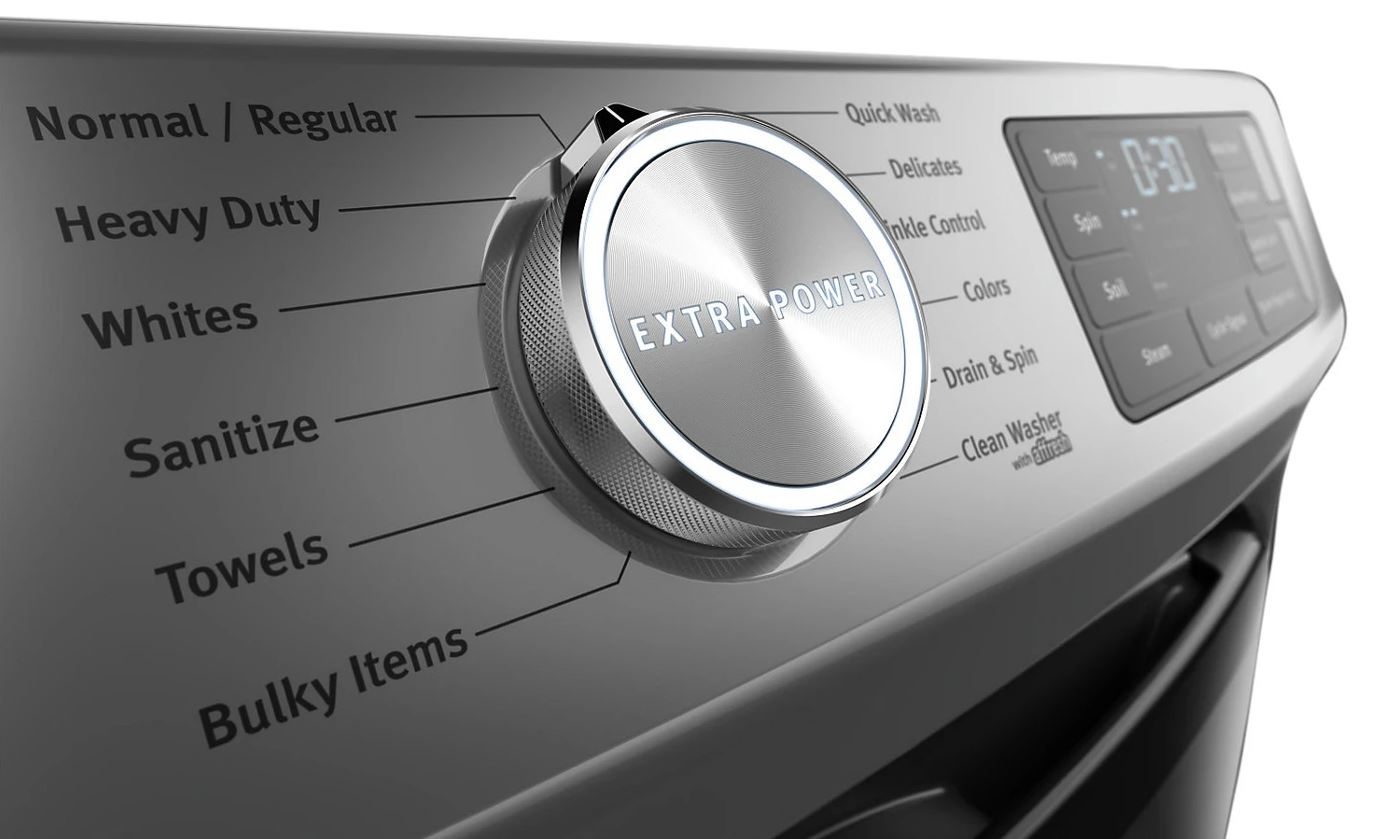
That's on the manufacturers for adding "sanitize" cycles: https://cdn.avbportal.com/magento-media/GrandBlog/mhw8630hc%...
Nasty aggressive washing agents have a pretty devastating effect on bacteria, molds etc. especially bleaching percarbonates and such used for whiteners/stain removers. Surely then it's just a matter of increasing the amount of washing powder to achieve the desired sanitation level.
A rule I use is that if soap suds aren't still present in reasonable quantity on top of water until the end of the wash cycle then there's not enough soap powder being used.
Perhaps the trend towards minimizing the amount of cleaning agents used in washing has gone too far.
Similarly, perhaps also we've gone too far by removing phosphorus (in the form of trisodium phosphate—aka TSP, etc.) from washing powders, which has been a trend in recent years through environmental concerns. TSP, Na₃PO₄, is remarkably good at removing heavily ingrained dirt. It's also highly alkaline and hostile to living organisms.
That said, surprisingly TSP is not very toxic to humans—at least in small amounts. It's used as an acidity regulator/preservative in food, it's E339.
Those of us with some chemistry knowledge do such things but those people referred to in the story are unlikely to even know about TSP let alone add it or anything else to washing except perhaps fabric softener.
I found the story lacking detail so I went to the source paper† and whilst detailed in parts I also found it quite unsatisfactory. For example, during the test only 14g of 'unspecified' detergent was added. That little amount added to my wash certainly wouldn't remove dirt or oily stains let alone blood stains (which you'd expect to find on dirty medical workers clothes).
Moreover, whilst the paper mentions there are differences between liquid and powder detergents (including rhise with enzyme) little else is said about them. (Surely one should know the exact nature of one's bactericide before one commences.)
Quote extract from paper's conclusion:
"It is however difficult to determine the antimicrobial efficacy of the detergent itself from this study investigations.…"
Why? Again, you'd reckon that would be prerequisite and part of the controls (i.e.: take a fresh concentration of 14g detergent in the equivalent of a washing machine load of clean water and test it then increase the concentration in steps until 99.99% of the bugs died (that level of kill is required of an effective bactericide).
"Several studies have showed that the HAI organisms MRSA and A. baumanii and other Gram-negative bacteria can survive washes performed under 60°C without detergent…."
"without detergent" — for heaven's sake, that's hardly relevant. Who would wash clothing without detergent? None I'd suggest let alone medical workers.
When one actually reads some of these papers one can only conclude that some conclusions are questionable. Perhaps we've a case of bullshit baffling brains (here I mean those funding the research). Had I been on the funding committee I'd have not been happy with this paper.
BTW, those conducting the research are all from a school of pharmacy, you'd reckon they'd know enough chemistry and quantitative analysis to conduct a more exhaustive test.
*†https://journals.plos.org/plosone/article?id=10.1371/journal....
That's more a quality issue though, I think. The fabric itself seems weak.
No such hypothesis was made.
Everything I have is cotton which is very resistant to such high temps.
This is one reason this study seems rather dubious. In fact all the machines (they provide a table with model numbers, one of which is not correct, i.e., “00” should be “DD”) are European front loaders, but what is more concerning is that a far as I could see, there seems to be no mention of whether or how the clothes were dried.
The problem I could see with European style/model front loaders is that they usually and often proudly use little water, water which could rinse pathogens that were released from fabric by soaps, rather than allowing them to effectively reattach to fabric, but that is just my theory, yet a valid consideration altogether.
Then there is the fact that three of the washer models are masher/dryer combos, which are not only notoriously bad at both functions but their performance and designs may have an impact on results too.
Another huge hole in this research is that there is no clear mention of the brand of detergent used, only the type, biological vs non-biological (presumably only one of each). From other common testing, we very well know that different detergents perform very differently, especially across the types of stains, let alone between machines, not to mention types of machines. So we must conclude, assuming all other things being fine, this research would only even be relevant in the UK.
But then there’s also the matter of whether the detergent, the amount of detergent, and even the washing machines are representative of those used not only in the UK, but by hospital staff at all. Nothing indicates that there was some questioning, let alone observation of staff on their usage, equipment, or practices.
Frankly, this research, even if it were only relevant to the UK is still full of huge holes, even some not mentioned that I won’t bother going into detail about.
It is the kind of research that grates me because it is such sophistry, has the appearance of science and the confidence in its conclusions, but in the details it just kind of falls apart as rather purely executed, assuming the best.
I wouldn’t even be surprised if someone did some digging and found conflicts of interest, even just indirect ones that the researchers are not even aware of. Backroom research, research for the purpose of driving a commercial agenda is far more common than people think. I know this for a fact because I’ve witnessed it in person many times, from the smallest levels mostly for personal “publishing” interests, to the highest multi-billion dollar expenditures that are basically little more than very elaborate, very orchestrated, very high level get rich con jobs.
Do you also sterilize your kitchenware? Well, given the population bias of HN, probably some of you do, but the vast majority of humankind do not. If you don't sterilize things you put into your mouth, I don't see why you'd expect this for clothes.
So it is amazingly unsurprising that consumer washing machines don't sterilize clothes. Just as you need to take extra care to sterilize kitchenware when you're doing anything fermenty, hospitals shouldn't have been relying on home washing machines.
The article is about “health care workers who wash their uniforms at home.”
Even desinfection does not kill everything.
Also no need to, bacteri and virus are a normal thing. The problem is, if too many of the wrong type get in your system. So reducing them in general (and also normal washing machines do that) is mostly sufficient.
(And dishwashers indeed kill microscopic life with heat and chemicals, but that is a side effect of cleaning)
Likewise for washing machines. If you read the paper you will see they only tested 6 machines and chose 60C as a theshold for some reason. Every machine I've used with a sterilize function uses ~76C water.
resteraunts that reuse dishes several times need a better plan but not my house.
In the US, the FDA requires commercial dishwashers to hit 165F. Consumer washers usually start around ~120F (from the water heater) but even my "landlord special" cheap GE washer claims to hit 140F, which is enough to kill off 99.99% of bacteria in just a few minutes.
So, yes, more or less involuntarily - although I certainly don't mind the lack of salmonella on the forks I use to prick chicken breasts.
Though I wonder what effect a standard load with bleach would have when used in a load or if that’s simply what the article refers to as their disinfectant test.
It's almost as though people forget these are machines that require maintenance and cleaning.
I suspect this was meant to reduce the fill water used in the subsequent load, but that's only sensible if you're doing laundry every day or two. If you go longer between washing sessions, it's just making clothes stinky. Perhaps it's backwash from water left in the discharge hose after the pump shuts off?
So for years, I just run the first cycle empty, hot, with a bunch of bleach. It wastes more water than this stupid measure could ever possibly save, but it keeps my clothes from being stinky.
That machine was just damaged in a flood so I'm shopping for a replacement as I write this, and I cannot for the life of me find this information in any reviews. Does it drain fully? How much water is left behind?
A friend pointed out that some machines have a little pigtail hose out the back with a manual drain valve on it, presumably meant to completely empty the machine before transport. Their theory is that I could put a solenoid valve on this and install my own tiny pump to finish draining the machine after a session, possibly a peristaltic pump which wouldn't be susceptible to backflow from the lift. But again, I can't find information in the reviews about whether any given new machine I might buy, has this little drain pigtail.
How I got rid of it.
1) do not use liquid detergents. powder only. My working theory is the medium used to make it gooey was sticking and giving the mold a good medium to live in.
2) do not use liquid fabric softeners. see #1. I use a fabric sheet on drying.
3) clean cycle once a month
4) washer tablet in with the wash clean cycle, I alternate with bleach every other month.
5) leave the door open between washes
6) drain out the water from the 'pigtail' once every 6 months, or whatever the documentation recommends. It is not just for when you move it. It is meant for the next step.
7) clean out the lint trap. Many have this just before the drain out and before the pump. That thing can get really gunked up. especially with liquid detergents/softners. I use the same schedule as the drain out.
#1 and #2 were the main sources for me. Took about 2-3 weeks before the smell was gone.
For my samsung I would say about a 1/4 gallon is left in the hoses.
I think washers may leave a bit of water in the "sump" so that the pump doesn't run dry. Running dry is typically not good for pumps. Shouldn't need to be a lot though.
7: I'm 99% sure none of my washers have ever had an integrated lint trap. I ziptie a mesh-sock trap onto the drain hose so it doesn't clog the washtub drain, and the amount of stuff it accumulates means that any machine-internal lint trap would've been clogged solid in the first few months. There's no mention of one in the manual, either.
I wonder if I didn't drain it upward into a washtub, but downward into a floor drain, if that would eliminate the water-left-in-hoses problem...
On mine it is a circular item that you can twist out. If I do it before draining water comes dumping out of that. So I drain then clean that thing. Bit of hot water and a bit of scrubbing.
If you're pouring bleach into your machine, it can erode the rubber seals. I use Dettol instead (I think it's called Lysol in the States), which seems to do the job.
Have you tried vinegar in the wash and wool dryer balls? I pre-wash with vinegar and add an extra rinse cycle. It's way better than fabric sheets and the balls also speed up the drying process.
And vinegar is a pretty good cleaning agent all by itself.
Is it a top loader? If so double check to make sure you are really hearing left over washing water and not balancing water.
Most top loaders have a sealed hollow ring around the drum, usually near the top but sometimes at the bottom, that is partly filled with water or a saline solution. The liquid in the ring redistributes itself around the drum during spin cycles in a way that counters an off balance load in the drum which reduces vibration and noise.
If you spin the drum by hand the balancing liquid sloshes around and it can be quite noticeable on some washers. Next time you are at an appliance dealer try spinning the drums in some of the top loaders on display. It can sound like a surprisingly large amount of water.
Sounds like is not draining properly, is it clogged up? Should use some vinegar on an empty cycle to descale the heater and all the drain holes.
We switched from a front loading washer back to a top-loading one hoping we'd get results similar to the top-loading washers from our youth. But nope. Funky smells, poor distribution of detergent, clothes that don't fully clean.
As sibling comment says, get yourself a Speed Queen, made with commercial parts and still washes the good old fashioned way [0].
0: https://speedqueen.com/speed-queen-difference/#classic-clean
2 months ago we discovered the boil wash. With some detergent containing bleach it stopped the smell, even if we leave the machine closed during the day.
I our case it's not we have forgotten but never discovered this function.
i think this is partly because in the USA, washing machines run on 120VAC. Heating the water would draw a lot of current.
My current washer (Samsung) has: deep steam, allergen, and sanitize.
Extra annoying: enabling eco mode (the one that is tested when generating the power usage stats on the sticker for these machines) on some machines will make it run "60 degree equivalent", which usually means "longer but at a lower temperature", which obviously doesn't work for sterilization at all.
Of course, this is rarely an issue for consumers who don't need to sterilize their clothes (except when a family member is sick with some specific illness maybe?). But, for hospital workers, which this paper is about, that's a different story.
Lower temperatures (e.g. 30-40 degrees C) may even provide a better environment for bateria and/or viruses to grow.
The 90c cycle is the only one I fully trust to get proper hot but I can't wash everything at 90
Still, maybe a failed machine is still a valid test - how many hospital staffs machines are unknowingly faulty?
A quick fix would be to swab staffs clean clothes every so often (or put a test patch in with their washes?) and check it.
Short cycle length certainly makes sense to be correlated with pathogens. The lousy LG "TurboWash" only takes 28 minutes to do a full load of laundry but certainly doesn't get very much clean in that time.
I have to admit it was surprising that textiles have been identified as the source of hospital acquired infections. You'd think that even if the laundering didn't eliminate pathogens, it would greatly reduce them and make any clusters more diffuse.
Seems like I ended up with a software-controlled washer that is not very straightforward in its behavior and it may have something to do with energy rating.
There's no setting to get a hot rinse, not even a warm rinse, as expected. All those were taken away decades ago on purely mechanical models anyway, but at least a "hot" wash is still there. A mainstream US washer uses the household hot water supply though, they do not self-heat the water. You have two separate water inlets to the machine, one for hot water, one for cold.
You put in the laundry, start a hot cycle, and the drum starts to fill by opening only the hot water supply. It keeps filling whether the top lid is open or shut but it will not start agitating unless the lid is down.
When the lid is open, you can feel how hot the water is as it pours in.
As soon as you shut the lid, the cold water opens up too at full blast even though you just wanted hot. You can hear it and feel it for a second if you open the lid, but then that cuts off the cold and all you get is hot as long as it's open.
Saves a lot of energy when things are not as hot as people think they are.
I remember finding a lawsuit, if I remember correctly, between Samsung and a certain municipality of an unremembered state.
The patent involved a lining within surfaces of the washing and drying systems for hospitals which impart silver particles. The marketing part suggested it would spare x amount of bleach and have equal or greater efficacy.
The municipal water waste management objected based on the breakdown phase of the sewage relying on bacteria. The silver, they surmised, would obviously hinder this process and so on.
Then, as a side note, you have products from waste management called eg Sludge, which is used as fertilizer. Supposedly it is forbidden on vegetable crops, but I once interviewed a cattle rancher who said his subsidies were dependent on his acceptance and use of Sludge.
Further aside, the real problem here is the 'forever chemicals' that accompany these products. It tends to permanently compromise the land it's used on.
I remember the rancher telling me he's seen his cows chewing on condoms.
But my state has also made it illegal to prohibit the use of clotheslines, a "right to dry" law.
I'm surprised you didn't know that.
Banning laundry hanging is much less common in the UK so harder to find examples. But POAs are reasonably common and enforce all kinds of things for aesthetic reasons.
Stop buying HOA homes, and people will stop forming them. The market has spoken and a lot of Americans love them.
If I had to buy a standalone home, I would probably have to pay considerably more and live in a worse part of the neighborhood.
With selection bias like that it's not surprising what you get.
Obviously other countries have various regulations around this stuff too, but it's just not as aggressive and not as wide spread as HOAs are in the States.
“Willingly” makes it sound like there’s a lot more choice in the process than there is. Many municipalities want a free lunch when it comes to approving new developments—they want all the tax revenue without any of the pesky costs of road maintenance, trash removal, drainage maintenance, etc. The solution? Approve the development with an HOA—now that’s the neighborhood’s problem (tax bills are still due in full though!). They apply this playbook over and over until the large majority of houses coming on the market are in HOAs. Buyers in these markets severely limit their choices (in an already limited market) if they eliminate HOAs from their search.
Is there a reason for this? I'm struggling to come up with a sensible reason tbh...
"My favorite example of this concept is the humble clothes line. Is it legal to dry your laundry in the sun where you live? In many parts of the country this is expressly forbidden by law and/or private binding agreement. This sort of activity is associated with rural peasants, impoverished slum dwellers, dirty hippies, white trash (or worse), and is at odds with the look and feel of a prosperous community. It might be a scorching day in August but everyone is compelled to operate a mechanical dryer in the house and crank up the air conditioning because anything else is shameful and verboten."
https://www.strongtowns.org/journal/2020/5/6/the-other-pitch...
Surely the only scalable solution in a medical context is to get workers to change out of uniform at work and hand over to industrial laundry service, everything else relies on procedure outside the work environment which not everyone is going to do reliably and is difficult to supervise / QC.
Article is about healthcare workers taking their laundry home, and the resulting sustained pathogens in a medical setting.
My own washing machine is nothing special (front-loader Euromaid, whatever was cheap ~10 years ago) and you can manually bump to temperature up to 70/80/90°C for a cycle (which adds some time). I haven't measured it though to see how accurate it is and I'd imagine 90°C at least isn't great for those rubbery painted patterns or general clothing integrity either.
I started using the higher temperatures occasionally since I have some old t-shirts, but I always have to stop wearing them since the underarms develop a crust - I guess it's some kind of bio-reaction between me, my bacteria ride hitchers, and deodorant. Higher temps do seem to delay this build-up (which seems impossible to clean off), but does seem to reduce the life expectancy of the clothing. When I see people (mostly women) still wearing shirts they got in high school, it makes me a little envious. Mine got that issue in < 5 years before changing the wash temps :(
That would never be allowed in the food industry.
You would place worn uniform in a bag labeled with your name and drop if off at the laundry to collect the next day.
Then privatisation came, first they shut down the tailors and you were expected to both purchase your uniform and pay for alterations and repairs (costs you could claim back as a tax rebate if you knew how, how not being advertised.) Then they privatised the laundry, shutting down the one on site and shifting everything to a central location, by everything I mean just the bedding, you were now expected to wash your uniform at home.
The only exception I am aware of is Surgical scrubs, those were provided in sterile wraps and were to be returned to a certain laundry bin for cleaning.
You're right about the food industry, when I worked in kitchens that days uniform was provided, freshly cleaned and returned for laundering at the end of my shift.
I would be genuinely surprised if the answer was "yes".
I'm willing to bet they launder bed linens almost exclusively. (And perhaps the food service uniforms) :-)
Probably helped it was a hotel ...
But i never worked in a restaurant, just guessing here.
Things like scrubs exchange machines and central laundries washing staff gear is rare even in hospitals in the developed world.
I think this should be taken care of by the employer.
Also though, you think people buying & wearing their own Figs scrubs would get them back if they put them in the hospital laundry service? And what about non-scrubs for that matter?
"Require" might be more appropriate.
And I agree - the medical industry (specifically in the United States) cares more about profit than care. It's nuts.
On my dryer, it says "sanitize with regular fabric selected (and manual time set to maximum)".
> Two commonly used UK washing detergents were selected for the assay: a non-biological liquid detergent (15-30%:Anionic surfactants; 5-15%:nonionic surfactants; <5%:phosphonate, perfume, soap, optical brighteners, methylisothiazolinone, octylisothiazolinone) and a non-biological powder detergent (5-15%: oxygen-based bleaching agents, anionic surfactants; <5%: nonionic surfactants, polycarboxylates, soap, perfume, phosphonates, optical brighteners, zeolites)
This doesn't really mean anything to me, but maybe it means something to you?
In some sense I think the real takeaway from the study is "we shouldn't be having healthcare workers wash their own patient/pathogen facing uniforms", and that takeaway seems robust against the hypothesis that only some detergents would solve the problem. As a population we can be sure that some of the healthcare workers are going to use the detergents that don't solve the problem.
> Each wash cycle was performed with either biological (14g per kilogram of fabric) or non-biological detergents (20g per wash).
But your quoted passage describes two non-biological detergents. So did they use a biological detergent or not?
Anyway, the first one sounds like Persil liquid:
https://www.ocado.com/products/persil-laundry-washing-liquid...
> 15-30%: Anionic surfactants. 5-15%: Nonionic surfactants. <5%: Perfume, Phosphonates, Soap, Optical brighteners, Methylisothiazolinone, Octylisothiazolinone
And the second one sounds like Persil powder:
https://www.ocado.com/products/persil-fabric-cleaning-washin...
> 5-15%: Oxygen-based bleaching agents, Anionic surfactants. <5% Nonionic surfactants, Polycarboxylates, Soap, Perfume, Optical brighteners, Zeolites, Tetramethyl acetyloctahydronaphthelenes
Not quite the same, but similar. Both are perfectly normal brand-name household laundry detergents.
It depends on what experiment in the paper you are looking at.
The supplemental section is addressing the "Laundry detergent tolerance induction assay" (a heading you can ctrl-f for) where they only used the non-biological detergent, "as biological detergent contains enzymes and other potentially disruptive components that may influence the assay".
If you go to the results section you will see results for both the biological and non-biological detergent under "Decontamination efficacy of domestic laundry machines" and so on. I didn't see anything specifying what biological detergents were used.