If you want to get inspired by what can be done with palletized framebuffers check out http://www.effectgames.com/demos/canvascycle/ (click Show Options) and the GDC presentation by the artist https://youtu.be/aMcJ1Jvtef0
With that you can fire up https://github.com/mriale/PyDPainter for that classic Deluxe Paint IIe vibe. Or, https://www.aseprite.org/ for something more modern.
I have no idea the names of nearly anyone but a CEO or lead Director in the games industry of the past 15 years.
For floors, unfortunately there's no such luxury, and if I remember correctly DOOM subdivided floors into patches, and only did proper perspective at the corners, and interpolated inbetween.
Blake Stone Rise of the Triad used later versions of the Wolf3D engine and had textured floors/ceilings
> Doom and IIRC Duke Nukem as well used a BSP engine which was much more flexible
Duke Nukem (Build engine) did not use BSP
The Build engine didn't use BSP, it treated connections between sectors as portals and rasterized the walls as (90 degree rotated) trapezoids while performing clipping against those portals. This allowed it to have dynamic wall geometry (e.g. moving trains, rotating light fixtures, etc) as well as "room-over-room" setups as long as you couldn't see both rooms at the same time (in both Blood and Shadow Warrior they found a workaround for it allowing to create more "3D" spaces by making identically shaped sectors with the floor of one sector acting as a portal to the ceiling of the other sector - supposedly this wasn't "natively" supported by the engine, but it was flexible enough for the game studios who used it -without even having access to the source- to do it themselves).
The first level of Duke Nukem 3D does use a few Build tricks - e.g. another one is that sprites can be "axis aligned" instead of following the camera and they can also have collision - this can be used to create rudimentary 3D geometry by treating each sprite as an axis aligned quad and in the first level it is used to make a bridge between two buildings (right before the level exit button).
Though your extender could make things a little more annoying on that front :-P
(DJGPP and Free Pascal -which use the same "go32" extender by DJ Delorie- do not do a full linear mapping so you need to do a bit more juggling to get stuff on screen there)
Some details are a bit too cool for 1993, though, and assume high frame rate (won't work that well at low fps). Smooth weapon animations with a lot of frames, tiny per-pixel effects on bullet holes and flash sprites, smooth movement and object position calculations that use precise math instead of fast rough estimates resemble Chasm: The Rift or Quake (the concept of idle animations, e. g. objects moving in the starting view of difficulty selection room, assumes that there is some performance to waste on details that make the world less empty).
It's not that rare, is it? Off-hand, and very mainstream; Perfect Dark, Mirrors Edge, Dishonored (don't remember if it's the first or second one), Metroid and more are all kind of "shooters" with female protagonist, although maybe Mirror's Edge is more just "first-person" than "shooter" to be 100% accurate.
Not to mention the large selection of "RPG + FPS" where you can be either man or woman.
---------
Seems the author also realize the thing with the pattern and likely gender of the cat:
> After all, I do need to give the protagonist his fair share. [image] (Yes, I know it's a female, but call it convention rooted in dialect.)
If you tally all the FPS releases in a given year, a supermajority are going to have male protagonists.
Mirror's Edge has a female protagonist, but it's not an FPS (First Person Shooter). It's a parkour simulator which technically lets you shoot a gun in limited sections of the game, but the protagonist is a pacifist and you get a bonus for decommisioning guns rather than firing them.
If the thread would like some hard data:
- 19,526 games on Steam tagged "female protagonist" https://store.steampowered.com/search/?tags=7208&ndl=1
- 13,578 games on Steam tagged "FPS" https://store.steampowered.com/search/?tags=1663&ndl=1
- 727 games on Steam tagged both "female protagonist" and "FPS" https://store.steampowered.com/search/?tags=7208%2C1663&ndl=...
So it looks like the two categorisations, for the most part, don't intersect.
Choosing one specific example when I also made more recent ones, isn't such a big dunk you think it is.
> If you tally all the FPS releases in a given year, a supermajority are going to have male protagonists.
Sure, I agree, I'm not saying it's more popular, just that I don't think it's that rare, but I guess ultimately I'm a bit nitpicky (sorry) and we're just disagreeing with the specific definition of "rare".
Edit: I completed forgot Chell from Portal, too!
https://unrealarchive.org/wikis/the-liandri-archives/Prisone...
No, this isn't a Perfect Dark game
[0] https://store.steampowered.com/app/1592280/Selaco/
[1] https://store.steampowered.com/app/1693280/Supplice/
[2] https://store.steampowered.com/app/1378290/The_Citadel/
[3] https://store.steampowered.com/app/3371240/Beyond_Citadel/
[4] https://store.steampowered.com/app/2443360/Zortch/
[5] https://store.steampowered.com/app/3807500/Zortch_2/
[6] https://store.steampowered.com/app/1051690/Nightmare_Reaper/
[7] https://store.steampowered.com/app/1785940/COVEN/
[8] https://store.steampowered.com/app/1406780/Viscerafest/
[9] https://store.steampowered.com/app/1072150/Hedon_Bloodrite/
I think the mix of highly rational reasoning and "it just feels right" is a killer combo too, it gives a rigorous basis for a lot of the decisions made, while also allowing for a strongly personal aesthetic to emerge. Very cool indeed.
It's refreshing to dust up trigonometry and good old low-level optimization tricks. When the scratchbuffer has 1 KiB and the stack can only use a fraction of that, it makes me realize how spoiled I'm at work with the microcontrollers we have, with threads being allocated 8 KiB of stack and backtraces with over 50 functions of C++ templates on it.
Those kind of constraints can lead to increased creativity, and can also influence the overall style of a game. It's part of the reason early 80's arcade games had so much diversity.
The flight simulator / magic carpet easter egg in Microsoft Excel 97 used that same shaded-colormap palette trick, plus some dithering:
https://rezmason.github.io/excel_97_egg https://rezmason.github.io/excel_97_egg/about.html
I'm impressed by your sprite pipeline and gibs animations. Your attention to detail and navigation of constraints have really paid off, I can't wait to play this sometime
The author seems to consider open-sourcing the engine, I would also be interested in the mentioned scripts for asset creation. Those scripts would make a great toolset for asset creation in this style.
The comments here are a cesspool unfortunately. People bickering about pronouns used for cats, how many shots it takes for a vase to explode, or whether or not some circa-1993 software was used or mentioned.
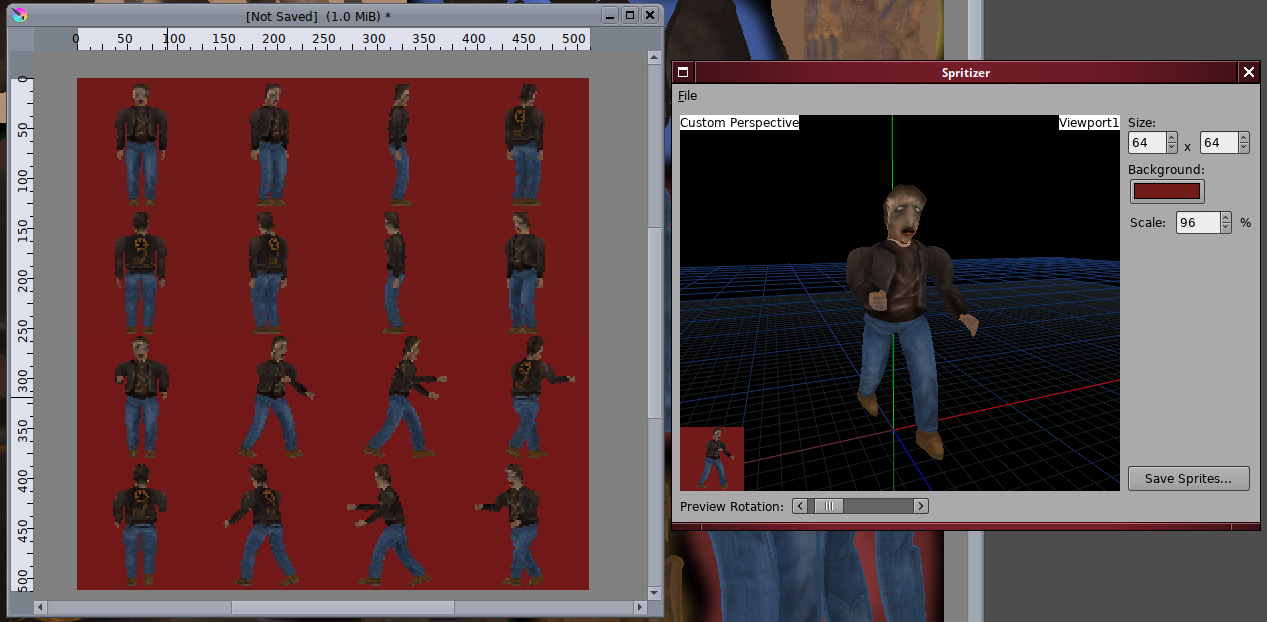
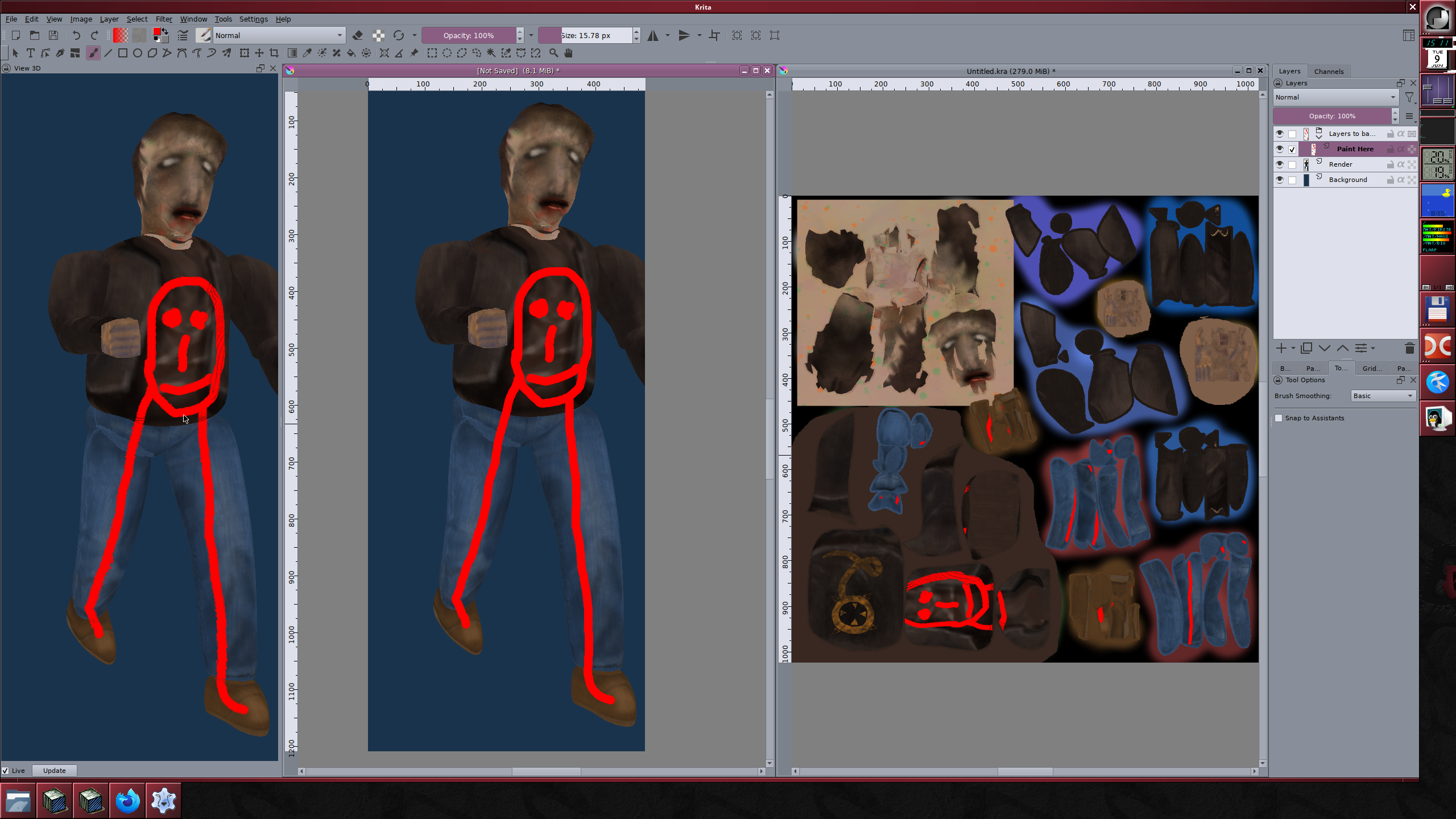
I did write a tool for generating the sprites from 3D models though[2]. It uses plain old OpenGL 1.1 to draw the sprite and grabs the framebuffer directly. It is drawn fullbright so i can paint the lighting directly on the sprite's texture (using a Krita plugin i wrote[3][4] - the model is something i threw together with Blender's default generated UV since i didn't care for the details).
I wonder if doing some sort of postprocessing (after rendering with with shading) like you do with your game would help with the finer details since i also found that rendering from 3D models to sprites creates very "mushy" results most of the time because of all the details getting lost. I notice the colors also become more saturated after postprocessing in your examples, is this after it finds the closest color in the palette or the result of the postprocess? I'd like to keep the overall hue+saturation of the model so maybe doing post-processing on a grayscale render to shade the shadows/dark areas but keep highlights as-is and then multiplying that with the fullbright image would produce results that wont shift the saturation.
[0] https://bad-sector.itch.io/post-apocalyptic-petra
[1] https://codeberg.org/badsector/PetraEngine/src/commit/14ca16...
[2] http://runtimeterror.com/pages/iv/images/95ddebc51e4dfa8a5af...
[3] http://runtimeterror.com/tools/kritaview3d/
[4] http://runtimeterror.com/pages/iv/images/535f0e09e590d8a1731...
It's the result of the Blender compositor postprocessing, just keep in mind it falls apart once you go low enough in resolution (it's an image space thing after all), so I'm not sure if that helps your case.
EDIT: Also, your project is very cool!
I think I'm gonna have to do it anyway, because some players claim they get nausea when playing at such low resolution (320x240), and the only way to give them higher resolutions that perform reasonably is to have it hardware accelerated.
Renderer is abstracted away already, but the real difference would probably be occlusion culling... With raycasting, I get it for free, but if I'd go down the hardware accelerated path I'd have to pick something more clever.
Raycasting and software rendering in general tends to scale poorly with resolution, even with vectorization and all the bells and whistles of modern CPUs.
As an example this[0] video shows the benchmark from Post Apocalyptic Petra running on my previous GPU (RX 5700 XT) which all it does is build a per-frame (client-side) vertex-buffer in OpenGL 1.1 (the engine was made for actual retro PCs running DOS and Win9x so it does some rudimentary occlusion culling but that mainly affects 90s hardware, not anything released since 2000 or so). If anything, the rendering has so little overhead that half of the framerate is "eaten" by the FPS counter overlay :-P.
Thinking about modern games, a single character model probably has more vertices than my entire level (and yours probably), so it's definitely reasonable to expect occlusion culling for such simple geometry might actually reduce performance rather than increase it.
Meanwhile more current games have much higher polycounts, easily going above 100K triangles - e.g. Dante from DMC5, a ~7 year old game, apparently has ~190K triangles and that had to run on the more anemic PS4/XBone hardware :-P (though i'm not sure if it used the full 190K model there or some cut down version).
[0] http://runtimeterror.com/pages/iv/images/1073c7062db40837240...
But ignoring the GPU you have on your system is boring
What I don't like is to see claims like "no AI slop"
And yet it's riddled with emdashes and language "by hand"
Seeing the skills of the writer, he definitely should be able to, but then I don't understand the claim.