Our first family computer was bought back in 1995. IIRC it was a 166 MHz Pentium / 16 MB ram machine with Windows 95. It cost around $3500-4000 back then, and that's not adjusted for inflation.
EDIT: As a side note, 3 years later I managed to get my hands on a copy of Half-Life, right after it was launched. Our computer, with standalone graphics card, was barely able to run the game. Back in those days, being a gamer and chasing cutting edge graphics was really expensive.
Prior to this we had a electric typewriter, and the main purpose of the machine was to be used for writing documents and other business activities. My first experience with programming, was editing HTML files. I then went to the library to look for books on programming, and the only book I could find there (rural nowhere with population 3000) was a book on Pascal, or possibly Delphi.
I was told that there was this one wiz kid in our small rural town that as supposed to be "really good with computers", he was a couple of years old. I hit him up, and the first thing I noticed in his room was this big "Borland C++" box on his shelf - he showed me a basic 3D flight simulator clone he was working on, as well as some sort of Doom clone. I was in awe.
Suffice to say, he did very well during the dot com boom. Skipped college, and went straight into employment.
A couple of years later, when I started in high-school, some older semi-retired developer had recently moved to town. He worked with our school, and offered a Java programming class. Really excellent teacher, and that was the moment I decided I wanted to work with computers.
Made for some funny exams afterwards...
The first was that my father purchased a PC in the early 1990s to help out with his self-employed publishing business, and like most PCs of the time, it came preloaded with QBasic and the source code for a couple of games like GORILLA.BAS that an introverted kid with a lot of free time could mess around with.
The second was attending a high school with a reasonably well funded computer lab and an unusually open minded computer teacher. If you demonstrated that you were dependable, he'd basically let you do whatever you want. While my school was mostly a Mac shop, I was a bit of a Microsoft shill in high school so by graduation I'd figured out how to stand up and run a Windows NT file & web server for our school newspaper. Another guy was a Linux nut and had been allowed to do something similar with RedHat for the school's drafting lab.
Inclination met opportunity, one thing led to another, and I went on to work with technology for the next 25 years of my life.
What worries me now is that so much technology is so locked down. It must be a very rare school today that allows the kind of freedom we had. There is no IDE preinstalled on a phone, and even merely installing an "unapproved" app is under fire.
If for no other reason, for the sake of the kids the industry, the tools, the operating systems need to be more open. They need to be tinkerable. That's how the most motivated kids tend to learn. Our best and brightest are not being made because we've closed things down to maximize some hedge fund's ROI somewhere. The financialization of America was a grave error.
With my kid I want to ensure that fundamentals of computing are understood as early as possible, this is what allows you to understand how the world is interconnected.
Seeing kids nowadays interfacing with just a touch screen makes me fearful that a foundation of knowledge is not being built, even among the more nerdy types.
This means that you could create cool looking graphics easily. For example, you can just compute the points of a circle and draw the points one by one, and in the screen it will show a full circle being drawn.
"Modern" graphics libs (even SDL I think), made this impossible by having redraw the whole screen every frame so that now my program has to remember all the points there the program drew before to get the same effect.
The former workflow made graphics programming so much fun for me and I find the modern "fast rendering pipeline" boring and not a lot of fun.
Things like that, one by one, have sucked the whole fun out of computing.
Impressive how that part changed. Today, many computers are cheaper than the desk they are sitting on. Many companies pay over $2000 for office furniture, and that's not even fancy. A $1000 laptop sits on top of it.
Furniture made by an actual cabinet maker will easily get to $5000+. About the price of a maxed out gaming rig, or an enterprise level workstation.
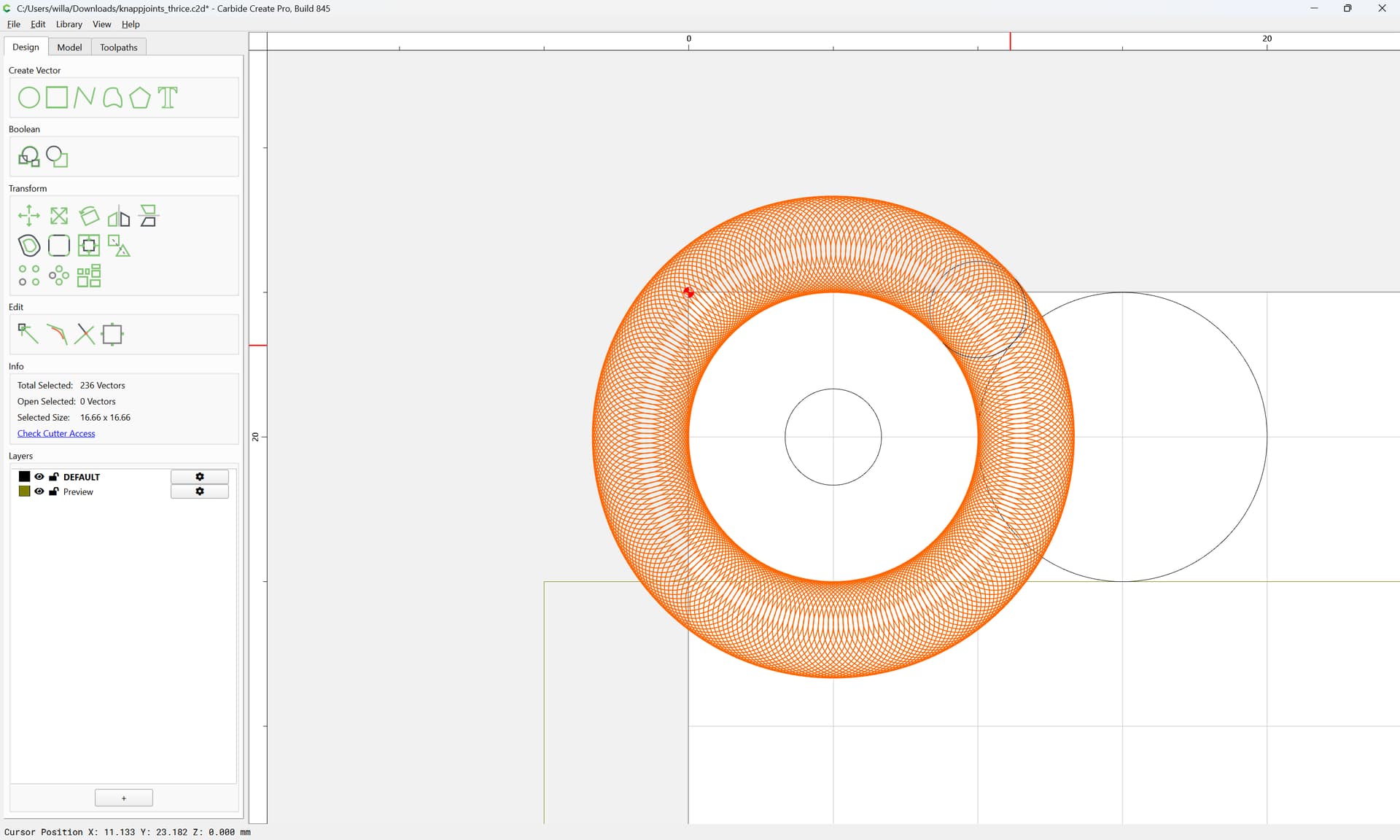
https://community.carbide3d.com/uploads/default/original/3X/...
(If someone knows a good/ideal technique for that, I'd be glad to learn of it --- my math background is kind of shaky)
I'm going to make two assumptions based on your screenshot:
1. The large circles A and B are touching each other
2. You know the radius (a,b,c) of each circle and want the third one (circle C) to touch both of the first two.
What I'd do is place the center of both circles A and B on the same horizontal line and choose a frame of reference such that the center of circle A is the origin, and the center of circle B is placed at coordinates (a+b, 0)
Now we are looking for the coordinates (x, y) of the center of circle C, placed above the x-axis. Which by the way is one of two solutions, as there is a symmetrical circle C' placed below the x-axis, with the coordinates (x, -y)
We know that if we traced a straight line from the center of C, it would intersect the x-axis at a 90° angle. So drawing that line creates two triangles which each have a right angle in this spot:
- one triangle on the left, where the hypothenuse goes from the center of A (0,0) to the center of C (x,y). Its length is the sum of the radii of A and C.
- one triangle on the right, where the hypothenuse goes from the center of B (a+b,0) to the center of C (x,y). Its length is the sum of the radii of B and C.
Both of these triangles share a vertical segment of length (y).
The left triangle's bottom segment has a length of (x) and the right triangle's bottom segment has a length of: (a+b) - x
We know from Pythagore that the square of the length of the hypothenuse is equal to the sum of the squares of the two sides of each triangle, so we know that:
    (a+c)^2 = x^2 + y^2

    (b+c)^2 = ((a+b) - x)^2 + y^2
    y^2 = (a+c)^2 - x^2 = (b+c)^2 - ((a+b) - x)^2

    (a+c)^2 - x^2 = (b+c)^2 - ((a+b) - x)^2
a^2 + c^2 + 2ac - x^2 = b^2 + c^2 + 2bc - ((a+b)^2 + x^2 - 2ax - 2bx)
    a^2 + 2ac = b^2 + 2bc - (a^2 + b^2 + 2ab - 2ax - 2bx)


    a^2 + 2ac = 2bc - a^2 - 2ab + 2ax + 2bx

    2 a^2 + 2ac - 2bc + 2ab = 2ax + 2bx

        a^2 + ac + ab - bc
    x = ------------------
               a+b
I did notice that in your screenshot A and B are of the same size, so if you knew this from the start it becomes way simpler.
x = a (of course the center of your new circle is at the vertical of the point where both circles touch, which is obvious due to the symmetry of the problem)
and
y = squareroot(c^2 + 2ac)
I am going to make a link to your comment from the forum post in question:
https://community.carbide3d.com/t/knapp-joint-with-cnc/19723 (scroll all the way to the bottom)
and will hopefully be able to translate that into Open(Python)SCAD code so as to make a generalized solution for my current project:
The school computer lab had Visual Basic but you only got an hour week in there as part of the computing subject, the school library computers couldn't have it because the licence was per seat not per site.
You really only had QBASIC which was great but we really wanted to write Windows apps. You'd be up for a thousand dollars for a MSDN academic subscription just to get Visual Basic.
I guess the blessing was instead of Windows apps we made web pages and JavaScript games hosted on our parents ISP webhost accounts while we dreamed of the day we'd have enough money to buy our own .com domain.
40 years later, and I've successfully managed to never use a Microsoft product.
People sometimes underestimate how important search engines are to build applications without official documentation.
Supporting FOSS is more than a convenience for some, as most remember locked ecosystems were not fun at any age. I remember GW-Basic and VB3.0 made building programs easy for kids, but it had other issues besides the license cost. Prior to Visual studio, making standalone binaries was simply too difficult for most until the Internet.
Now the average AAA game is around 40GiB on Steam, and g++/clang is the standard tool-suites. Fun times, =3
I also remember that the game speed was set to some factor of the computer's clock speed. When I later tried to run the same game after I upgraded my hardware, the game went so fast, you could not even play it.
- Oregon Trail
- Where in the World is Carmen Sandiego
- Super Solvers (the best of the lot)
I also got a Windows 95 IBM Aptiva PC from my parents that had a lot of educational software. I can only remember some of it:
- The Lost Mind of Dr. Brain (I loved this game - it had logic programming, 3D spatial reasoning tasks, biology, ...)
- Encarta Encyclopedia virtual maze
- Mavis Beacon Teaches Typing (I hated it; I learned to type when I got onto IGN Boards, EZboards, AIM, and IRC.)
- King's Quest VII (this counts as educational logic puzzles, right?)
- MechWarrior II (well, I considered it educational...)
I'm envious of kids today growing up with LLMs and vibe coding. I would have had a blast at that age with the tools we have today.
Nostalgia for the old web - building websites in HTML on Angelfire and Expage.com. Learning programming on visual basic and how to copy and paste <marquee> to welcome people to the site and to sign the guestbook…
There is a lesson in there somewhere that humanity has not yet woken up to.
I think they became less interesting because they became more homogenous, more standardized, more commercialized
It's like the internet. It was more interesting when everything was spread out and you felt like you had to explore it. Now it's all the same content collected on the same 5 sites, and it feels like there's nothing actually interesting out there anymore
I think it started becoming less interesting as it grew more powerful and with it came more capable displays and GUI interface, and before you know it, computers are indistinguishable from a damn television.
At least for me as computers started showing more realistic graphics, it became less abstract, less magical, less interesting. After all, reality is pretty boring...Not sure how we collectively missed that fact...
There's probably also an aspect of "The computer used to be a place you would go, now it's a rectangle that comes everywhere with you"
It's definitely less magical when it is everywhere and in everythin
You're not alone in missing the magic though. I miss it too